A Demineralization Treatment Plant (DM Plant) is designed to remove dissolved minerals, salts, and impurities from water to produce high-purity water suitable for industrial applications. The plant uses ion exchange technology, where cation and anion resins remove dissolved ions such as calcium, magnesium, sodium, chlorides, and sulfates from raw water.
The process typically involves cation exchange, degassing, and anion exchange units, which together produce demineralized water with very low conductivity and TDS levels. This treated water is essential for industries where high-purity water is required to prevent scaling, corrosion, and contamination.
Demineralization plants are widely used in power plants, pharmaceutical industries, chemical processing units, boilers, and laboratories. The system ensures consistent water quality, improved equipment life, and efficient industrial operations.
Specifications
| Parameter |
Specification |
| Plant Type |
Demineralization (DM) Water Treatment Plant |
| Capacity |
500 LPH 50,000 LPH |
| Technology |
Ion Exchange Resin Technology |
| Material of Construction |
Mild Steel / FRP / SS304 |
| Raw Water Source |
Borewell / Surface Water |
| Operating Voltage |
220V / 380V / 415V |
| Automation Grade |
Semi-Automatic / Automatic |
| Water Recovery |
90% 95% |
| Inlet Water Conductivity |
Up to 1000 S/cm |
| Outlet Water Conductivity |
1 10 S/cm |
| Application |
Boiler Feed, Process Water, Pharmaceuticals, Power Plants |


 Mon-Sat 9.00 AM to 6.00 PM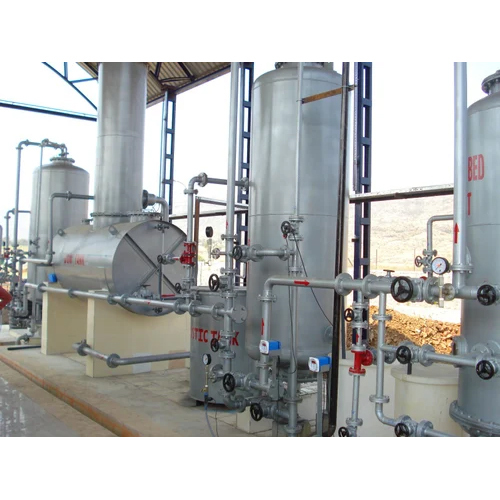

 Send Inquiry


 Send Inquiry


 Send Inquiry
 Send SMS


 English
 Spanish
 French
 German
 Italian
 Chinese (Simplified)
 Japanese
 Korean
 Arabic
 Portuguese